

Powder metallurgy pressing involves many batch components, modest weight per batch, and frequent grade changeovers, so a fixed batching line is often held back by the number of silo positions and by line cleaning time. The Sihyde powder metallurgy automatic batching line uses a mobile cart carrying a weighing hopper, weighs silo by silo along a single-row or double-row silo arrangement, and docks with the downstream equipment at a designated discharge port once weighing is done, stringing delivery, weighing, mixing, and dispatch work orders into one path.
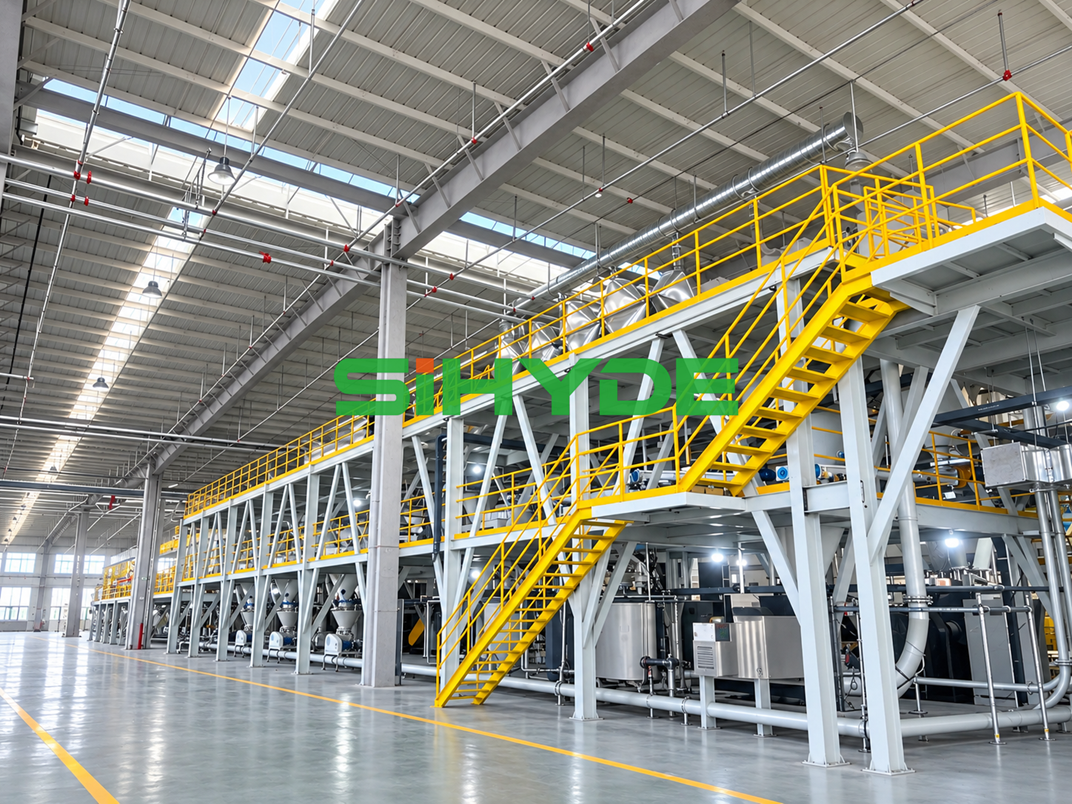
Combining mobile delivery with fixed silos
Silos laid out to the site: Raw material silos are arranged in a single row or a double row, and the number of rows is set by the plant span and aisle width; the number of silos ranges from 1 to more than 100, and single-silo volume is 1–100 m³.
The cart travels by recipe: The cart carries a weighing hopper and stops in turn beneath the silos that need weighing according to the recipe setting, one silo at a time, so no separate weighing station is needed for each component.
Fixed and mobile roles divided: The silos, feeders, and discharge ports stay in place while the weighing hopper travels, so piping and wiring do not expand as stations are added; for the mechanism composition, see the mobile cart system.
Weighing hopper weighing and discharge docking
Cumulative weighing silo by silo: The weighing hopper receives material beneath the silo, the weighing unit is configured at 10–1000 kg per scale, and batching accuracy is ±0.5% F.S. to ±1% F.S., where F.S. = full scale, i.e. the upper limit of that scale's range.
Stopping at the discharge port: Once weighing is complete, the cart stops at the designated discharge port; there may be a single discharge port or several, laid out according to the mixer position.
Telescopic chute docking: When the downstream equipment has an automated open/close valve, the discharge port docks through a telescopic chute and the valve opens to discharge after alignment, which reduces dust escaping to the outside. For the docking method, see the mobile cart batching system.
Mixing and batch consistency
Mixing parameters set per batch: Mixing time of 1–30 min and mixing volume of 0.1–4 m³ are selected by batch weight; with a double-spiral conical mixer configured, mixing homogeneity is ≥98% (double-spiral conical mixer only).
Batch number generated with weighing: One batch corresponds to one set of weighing records and mixing parameters; the number is generated at weighing, and the following process steps keep the same number.
Line cleaning by procedure at batch change: At grade changeover, the weighing hopper, telescopic chute, and mixer inner wall are cleaned to reduce carryover between batches.
Control and dispatch
Four control options: The line can be configured with PLC control, DCS distributed control, FCS fieldbus control, or SCADA data acquisition and supervisory control, selected by scale and depth of management.
Management in four modules: Raw material inventory, production process, quality, and logistics management are presented as separate modules on one platform, with weighing records and inventory deduction kept in step; for the configuration, see the electrical control system.
Work orders sent straight to the line: The production department issues dispatch work orders in the system directly to each production line on site, and the cart takes tasks in dispatch sequence, which reduces handover mismatches.
Application Scenarios and Customer Cases: Pre-Pressing Batching and Multi-Grade Changeovers
The differences the powder metallurgy automatic batching line shows across three scenarios mostly lie in the number of components, changeover frequency, and plant conditions.
Multi-component batching ahead of powder metallurgy pressing
Many components, wide weight span: Pressing batches often contain iron powder, copper powder, graphite, and lubricant, and the weighed value of each component differs widely, so the weighing hopper is selected at 10–1000 kg per scale.
Accumulated in one hopper: The cart weighs silo by silo in recipe sequence, the batch components accumulate in the same weighing hopper, and at the discharge port they are discharged into the mixer in one go.
Dust containment for powder: Iron powder is fine, so the weighing section is enclosed and the valve opens only after the discharge connection is seated, which reduces powder escaping into the workshop.
Small-batch changeover across multiple grades
Grade differences held in the recipe table: The components and sequence of each grade are written into the recipe; at changeover the recipe is recalled and the silos and travel path are sorted automatically.
Small batches not tied to a large line: Batches are dispatched by order and the cart travels by order, so one set of silos can take small-batch orders across several grades.
Records that can be traced: The batch number runs through weighing, mixing, and discharge, and composition deviations can be traced back through the records by batch; this kind of batch management works in a similar way on the food batching system.
Single-row and double-row layouts in space-constrained older plants
Rows set by span: Where the span is narrow, silos are arranged in a single row against the wall; where the span is sufficient, they are placed back to back in a double row with one cart aisle left between them.
Aisle left for the turning radius: The travel aisle is reserved to the cart's turning radius, and silo spacing is set by the weighing hopper outline and the maintenance space.
Retrofit with little civil work: Whether silos sit on the floor or are raised is decided by floor load capacity, and control cabinets and discharge ports are placed close by, so the retrofit consists mainly of setting equipment in place.
Frequently Asked Questions: Cart Selection, Row Layout and F.S. Accuracy
Q1: How do I choose between a mobile cart batching line and a fixed batching line?
A1: Look at the number of components, changeover frequency, and weight per batch. Where there are many components, grades change often, and batches are not large, a mobile cart uses one weighing hopper to travel the silos in turn; where components are fixed, batches are large, and the takt is tight, a fixed line puts a scale at each station so weighing runs in parallel on a short cycle. The two can also be combined, with main materials weighed at fixed stations and minor materials delivered by cart.
Q2: How is single-row versus double-row silo arrangement decided?
A2: By plant span and aisle width. For a narrow span with few silo positions, use a single row, with silo bodies against the wall and the cart travelling along one side; where the span is sufficient and there are many components, use a back-to-back double row, which fits more silo positions into the same footprint.
Q3: Why is accuracy expressed as F.S.?
A3: F.S. = full scale, i.e. the upper limit of that scale's range. The ±0.5% F.S. to ±1% F.S. error is converted against the upper limit of the range, which is not the same thing as a percentage of reading converted against the current weighed value: when the same scale weighs a small amount, the magnitude of the error does not change, but the percentage of reading it converts to grows larger.
Conclusion
The powder metallurgy automatic batching line draws delivery, weighing, mixing, and dispatch into one path: silos are arranged in a single row or a double row to suit the plant, the weighing hopper receives material silo by silo as it travels with the cart, and once weighing is done it docks with the downstream equipment at the discharge port. For a workshop running many grades in small batches, changeover comes down to recalling a recipe, and each batch is locked by its number.
