

The most common waste in green compact workshops is not in weighing but in silo positions calculated wrong: with too few silos, every grade change means transferring and emptying silos; with too many, material sits in a silo for months and fluidity degrades first. When building an automatic batching system, Qingdao Sihyde Automation Equipment Co., Ltd. puts silo count, silo capacity and scale range on one sheet to calculate, sets the layout by component count, single-batch weight and grade-change frequency, and routes powder and granular materials through separate channels.
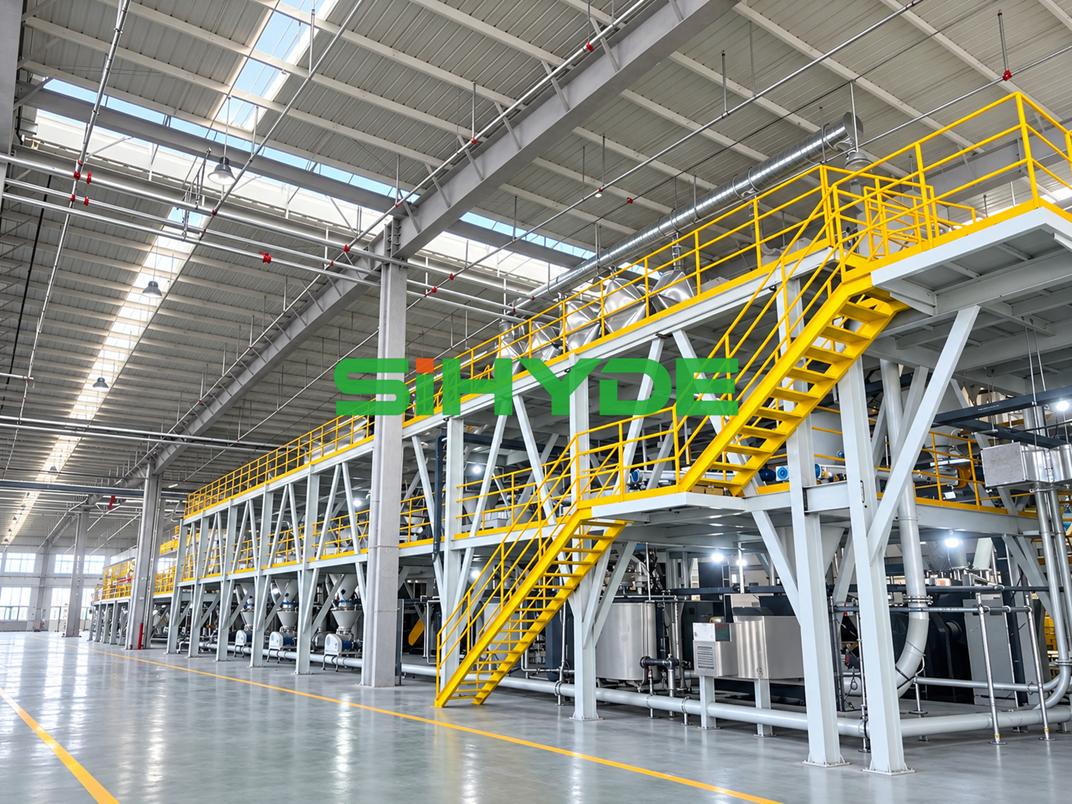
Core Module Breakdown: Silo Count, Silo Capacity, Layout and Expansion
Silo positions are not just a line on an equipment list — they determine changeover time, line-cleaning frequency, and whether materials can be added later.
Silo Count Set by Component Count and Grade-Change Frequency
• Look at component count: How many materials a recipe contains — the silo count must at least cover the union of frequently used components; storage silos can reach 1–100+, allocated silo by silo according to material types.
• Look at grade-change frequency: In workshops that change grades often, frequently used components each get a dedicated silo and rarely used components share common silos; at changeover only the common silos are switched and the dedicated ones stay untouched.
• Look at single-batch span: One silo must serve both large and small batches — silo capacity is sized with headroom above the single-batch maximum, and small batches are controlled by feeder speed regulation rather than by switching silos.
Silo Capacity and Weighing Cell Range Matched in Pairs
• Silo capacity range: Single-silo volume of 1–100 cubic meters, chosen by daily consumption and replenishment cycle: silos replenished frequently take the lower limit, silos fed by full-batch raw material deliveries take the upper limit.
• Weighing cell range tiers: Weighing units from 10–1000 kg per scale: main materials use large-range scales and minor materials use separate small-range scales, so minor materials no longer show reading jumps on large-range scales.
• Accuracy labeling: For batching lines with a mobile cart carrying a metering hopper, batching accuracy is ±0.5% F.S.~±1% F.S. — F.S. means full scale of that scale, which is not the same thing as a percentage of the reading; state the basis clearly at selection.
How to Choose Between Single-Row and Double-Row
• Look at plant span: Workshops with a narrow span arrange silos in a single row against the wall and leave the aisle for carts and maintenance; workshops with enough span go double-row back to back, cutting the material-taking travel in half.
• Look at material-taking method: Fixed batching lines arrange silos around the weighing station in recipe order; a mobile cart line serves many silos with one cart — the longer the silo row, the more pickup points per trip.
• Look at retrofit cost: Adding a line in an old plant is mainly about getting equipment in place: silo bodies enter in sections, civil works concentrate on foundations and flooring, and column spacing is not touched lightly.
Reserve Expansion and Interfaces Early
• Silo position reserve: Reserve positions and silo-top interfaces for materials likely to be added in the next two or three years; when expanding, only silo bodies and feeders are added and the main controller is untouched; the silo position table and recipe structure of the automatic batching system are updated in sync, so a new silo does not become an island.
• Control architecture: The control layer can be PLC, DCS, FCS or SCADA — select by degree of equipment dispersion and data needs, and add nodes onto the existing architecture when expanding.
• Mixing section matching: Mixing volume 0.1–4 m³ and mixing time 1–30 min — once silo capacity is enlarged the mixing section must be recalculated in sync, otherwise the front end batches fast and the back end cannot finish mixing.
Application Scenarios and Customer Cases: Powder Metallurgy Green Compacts and Multi-Grade Shared Lines
Green compact batching is characterized by many components, small batches and frequent grade changes; the silo layout of an automatic batching system directly decides whether a changeover takes ten minutes or half a day. The following is scenario analysis with no named customers involved; combinations of silo bodies and material-taking methods can be compared with the [mobile cart batching system](https://www.sihyde.com/306.html).
Multi-Component Shared Lines for Cemented Carbide and Iron-Based Green Compacts
• Wide component span: Main materials and trace additives differ by orders of magnitude in dosing volume; once scales are tiered by range, minor materials are no longer "swallowed" by large-range scales.
• Grade switching: Recipes are stored in the control system; a grade change calls up the recipe, silo numbers and feeding order come with it, and operators do not touch the mechanical structure.
• Batch traceability: Batch numbers are generated at weighing and run through weighing and mixing; composition deviations can be traced back by batch, giving evidence for complaint review.
Layout Where Old-Plant Span Is Limited
• Single row against the wall: When span is insufficient, silo bodies are arranged in a single row and the cart travels along the aisle to take material; aisle width leaves room for long-item maintenance.
• Sectional entry: Silo bodies and frames are transported as modules and positioned on site in installation order, reducing plant openings and lifting windows.
• Clear-height check: Silo-top dust collectors and inlet ports take up height; when floor height is insufficient, relocate the dust collector or switch to central dust extraction instead of forcing the silo body lower.
Scheduling for Small Batches and Many Varieties
• Shared-silo strategy: Rarely used components share common silos; changeover cleans only the common silos while dedicated silos are exempt, compressing line-cleaning time into the changeover cycle.
• Staggered replenishment: Replenishment windows are scheduled by daily consumption so multiple silos do not feed simultaneously at peak times, keeping dust extraction and conveying from being dragged down by instantaneous airflow.
• Data trails: Every weighing, replenishment and silo switch is recorded; month-end checks of raw material consumption against finished output balance.
Frequently Asked Questions: Silo Count, Silo Capacity and Adding Silos
Q1: Are more silos always better?
A1: No. Silo count is set by the union of frequently used components and grade-change frequency; redundant silos dilute per-silo turnover and lengthen the time material sits in storage, and powders with poor fluidity are more likely to cake. The silo configuration of an automatic batching system should be reviewed together with the recipe structure.
Q2: How should silo capacity be estimated to be reasonable?
A2: Daily consumption multiplied by the replenishment cycle, plus a margin of 10% to 20%. A single-silo volume of 1–100 cubic meters is the selectable range: raw materials delivered in full batches take large silos, components needing frequent replenishment take small silos. Once silo capacity is fixed, verify the weighing cell range and feeder capability next — the order cannot be reversed.
Q3: If materials are added later, must the line stop for retrofit?
A3: Usually only the corresponding silo position stops. Add a silo body, add feeders, add a node on the control architecture; the main controller and recipe structure stay untouched. If the new material exceeds the original silo capacity or needs a new conveying path, a shutdown window is scheduled according to the scope of modification.
Conclusion
Accurate silo sizing means one less silo emptied at changeover and one less month of material sitting in storage. An automatic batching system checks silo count, silo capacity, weighing cell range and mixing capability on one sheet, then sets single-row or double-row by plant span — at expansion you add positions, not start over.
