

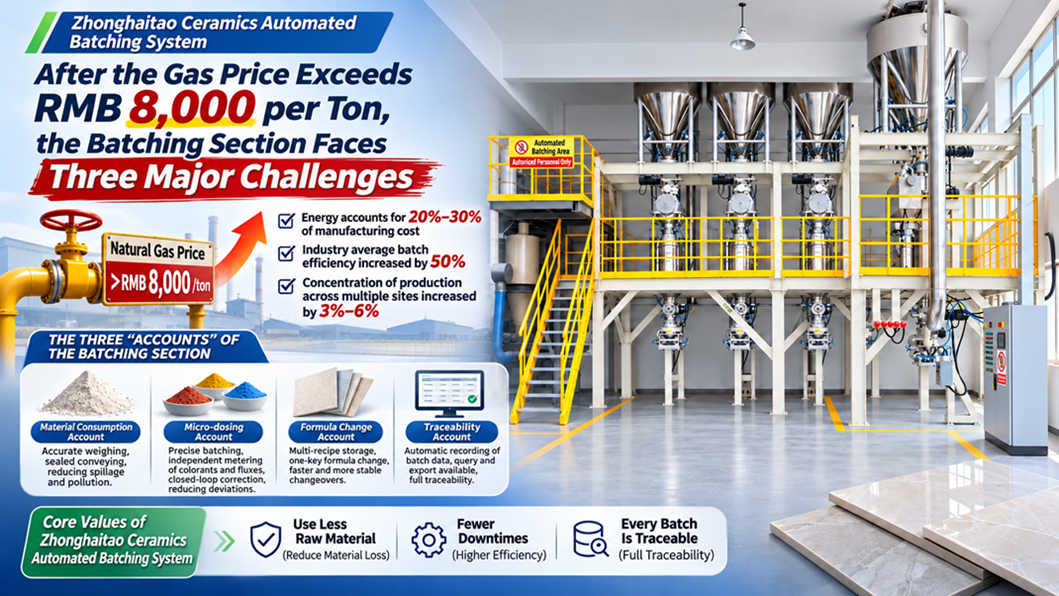
Since late October, China's building-ceramic production regions have entered the sixth round of concentrated price increases this year, and the reason tile makers give is nearly identical: natural gas has topped 8,000 yuan/ton in some regions, energy accounts for roughly 20%–30% of manufacturing cost, and only about half of the industry's kilns are running. With the pressure pushed down to the recipe level, what Sihyde's ceramic automatic batching system can do is keep every weighing record, recipe call and batch number inside the system, so cost reduction becomes something a plant can audit.
Behind the Price Letters: Cost Is Pressed Down to the Recipe Layer
Gas crosses the line: In some Guangdong and Shandong production regions, gas prices have exceeded 8,000 yuan/ton, a psychological threshold in the industry; energy takes about 20%–30% of manufacturing cost, so every step up in gas price moves the cost carried by each square meter of tile.
How the increases are issued: Between late October and November 1, producers in Guangdong, Guangxi, Shandong and Jiangxi sent out price letters in succession; most raised prices across the board by 3%–6%, or by 0.2–0.5 yuan per tile by specification; regions priced by area raised 2.5 yuan/㎡, with an energy-linkage clause — prices renegotiated when LNG exceeds 9,000 yuan/ton, and the increase cancelled if it falls back to 7,500 yuan/ton.
Kilns going cold: The industry's kiln operation rate stands at about 50%; some lines in Guangdong have stopped firing, and some tile makers plan to halt production in November with little chance of restarting this year. As output falls, fixed costs spread thinner, and material loss and rework in the batching segment get amplified.
Limited pass-through: Terminal prices are hard to raise in step, so part of the cost has to be absorbed internally — and there are few places to absorb it: material loss, changeover downtime and shade-difference rework, all three in the batching segment.
The Three Accounts in the Batching Segment, and How to Make Them Clear
The material-loss account: The automatic batching system weighs feldspar powder, quartz powder, kaolin and clay to recipe ratios; batching and conveying run through enclosed pipework fitted with moisture-proof and dehumidifying devices, reducing spillage and cross-contamination; for clay and other adhesive materials, a special anti-blocking discharge structure keeps the silo bottom and pipelines from holding material.
The micro-dosing account: Colorants and fluxes are used in small quantities at high unit prices; they run on independent weighing modules that do not share channels with the large weighing range of base materials, so the range gap does not distort small doses; closed-loop feedback corrects the metering process against weighing results.
The changeover account: Recipes support multi-group storage and one-click recall; when a product is switched, the discharge order and weighing parameters of each silo come with the call, so operators do not re-key numbers machine by machine; when scheduling by specification, downtime is compressed into recipe switching.
The traceability account: Every batch's weighing data is recorded automatically, queryable and exportable; material use can be compared batch by batch before and after the price increase, and when a complaint comes in, the batch and the recipe can be traced back from the finished product.
Kiln Stops, Restarts, Fuel Conversion: The Line Follows the Schedule
Intermittent production: Between shutdown and restart, moisture pickup and caking of material left in silos is the first problem. Enclosed pipework with moisture-proofing and dehumidifying, and anti-blocking discharge structures tuned for clay-type materials, solve discharge flow first, then metering stability.
Fuel conversion: From November 15, the whole city of Foshan becomes a high-pollution fuel ban zone, and ceramic spray-drying towers must switch to clean energy. Once the thermal process and fuel change, the recipes and batch records in the automatic batching system still have to reconcile with the finished products; electrical control and dust collection need to be planned in the same round, not one after another.
Multi-product on one line: When orders fragment, silo count is planned by product variety and recipe components; colorants and fluxes take separate channels; recipe parameters are managed by product model to reduce repeated commissioning in shared-line production.
Residual material management: Before a shutdown, clear the silo residuals and in-process batches so the system's batch records reconcile with physical stock; on restart, recipes are recalled from records, not from memory.
Four Questions to Ask Before Selecting
The material list: How many base materials and micro components, their bulk density and adhesion, and whether colorants and fluxes need independent channels — this list decides the silo count and the metering channel count.
Changeover frequency: How many recipe changes a day and how many varieties a month decide the recipe storage groups and the silo configuration.
Metering method: Base materials in graded weighing, micro components in independent metering, no shared weighing range; out-of-tolerance weighing needs alarms and defined handling actions.
Downstream connection: How feeding, dust collection and packaging join the same line, and where the interfaces sit, must be settled before the retrofit starts.
Frequently Asked Questions
Q1: With gas prices high and orders thin, should we retrofit the kiln or the batching segment first?
A1: The two cover different things. The kiln is the largest energy consumer; the batching segment governs material loss, changeover and batch consistency. If the workshop changes products frequently and colorant batches fluctuate visibly, start with the recipe management and metering of the automatic batching system — the investment is relatively contained; if the cost pressure sits in firing, the thermal retrofit goes first. The order should be assessed against the workshop's own situation and product mix, not copied from a template.
Q2: With frequent changeovers, how do we keep materials from mixing?
A2: Through two threads — recipe and batch. Recipes are stored in the control system and recalled with one click, switching the weighing parameters and discharge order together; every batch's weighing values hang on a batch number for later review. The equipment holds the parameters, but silo clearing and material changes still need people — the two do not replace each other.
Q3: We only want to retrofit the batching segment of an old line — is that feasible?
A3: Storage, weighing, conveying, dust collection and control each form a segment, so the weak link can be upgraded first and then linked with the existing kiln and packaging. Before the retrofit, sort out the material list, the workshop space and the existing equipment interfaces, so the new segment can actually connect to the old one.
Conclusion
Gas prices and kiln shutdowns are industry-level events; material loss and changeovers are workshop-level ones. Sihyde's ceramic automatic batching system weaves recipes, weighing, conveying and batch records into one line: enclosed pipework keeps out moisture and dust, micro components are weighed separately, recipes are recalled in one click, and batch data is queryable and exportable. For a ceramic plant working through its cost accounts, the line answers three concrete things — less material spilled, less downtime per changeover, and every batch traceable.
